
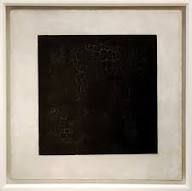
Malevich's Black Square 1915
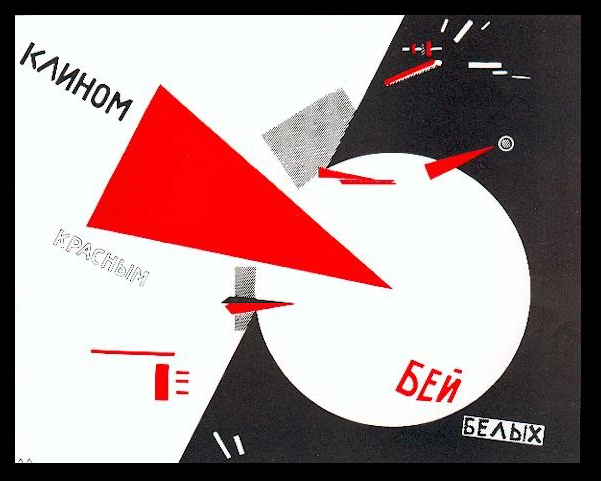
Beat the Whites with the Red Wedge
El Lissitsky, 1919
Constructivism
Abstract Functional Theology
“Its purpose was to celebrate the power of industrial civilization while projecting a confidence in the future and belief in social progress.”
(French and D’Andrade, The Type Project Book)
BOLD, DYNAMIC AND IMAGINATIVE reflects the typographic age of Constructivism. Art and design were tools for social progress. Typography behaved as a functional medium for communication. Constructivism was highly rational, utilitarian and politically driven, aiming to serve the new Soviet society through function and accessible design.
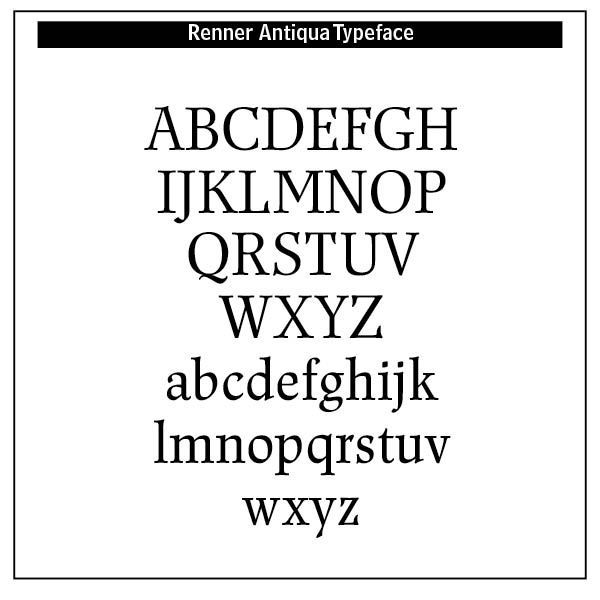
A dear friend of mine commenting on his tour of Russia in the 1990s noted that it was cold, dark and grey. Not exactly happy and inviting. Yet out of such greyness the Constructivist movement produced strong, sans-serif (without feet) fonts like the typeface molot used in the opening versal. Like Dadaism in some aspect, typography was bold, in-your-face, promoting Suprematism’s geometric abstraction and Futurism’s emphasis on dynamism.[1]
Suprematism
Suprematism was an abstract art movement founded by the Russian artist Kazimir Malevich around 1915. Its philosophy was an attempt to move art beyond the representation of objects and toward the pure experience of feeling, perception, and consciousness. The term comes from Malevich’s idea of the supremacy of pure artistic feeling.
Suprematism was Malevich’s attempt to liberate art from the representation of physical objects so that color, geometry, space, and movement could express a more fundamental experience of pure feeling and non-objective consciousness.
For the history and theology of typography, Suprematism is especially important because it helped establish the philosophical foundation for treating the page as an abstract visual field—an idea that became central to Constructivist, Bauhaus, and modernist typography.
Rather than art representing the visible world, painting and type can have meaning through color, shape, space, and movement alone. The famous Black Square (1915) became the movement’s emblem — an apparently simple geometric form intended to represent a radical departure from traditional pictorial representation.
Suprematism was not simply about putting geometric shapes on a flat surface. Malevich became interested in the sensation of forms floating through an undefined space. Rather than traditional Renaissance perspective, which organizes objects within a recognizable physical environment, Suprematist space is often infinite, weightless, non-geographical, dynamic, and unanchored. This gives many Suprematist compositions a sense that the shapes are moving or existing in a cosmic space.
Suprematism had a significant spiritual and philosophical dimension, although it should not simply be equated with Christian theology or conventional religious art. Malevich used religious and mystical language to describe the movement’s aspiration toward a reality beyond ordinary material appearances. The Black Square, for example, was presented in a deliberately quasi-religious manner when exhibited in 1915.
The square’s position in the exhibition—traditionally associated in Russian homes with the “beautiful corner” or icon corner—gave the work an intentionally provocative spiritual resonance. Malevich was therefore asking a profound question — Can an abstract work of art function as an encounter with something beyond ordinary objects?
Its principles encouraged designers to think of a page as an arrangement of geometric shapes, lines, asymmetrical elements, contrasting scales, directional movement, negative space, and abstract visual relationships. These ideas fed into the broader development of Russian Constructivist graphics, Bauhaus design, De Stijl, and later International Typographic Style.
Such artistic projectionism has found its way into spiritual mysticism in theological circles. Current yoga “centering” practices and other forms of Christian based meditation practices are designed to move us beyond the visible, beyond ourselves, to the infinite in God. However, healthy Christianity resists the tendency to become turned in on ourselves or engage in mysticism. Christian meditation practices are not merely abstract “imaginings” or encounters with the “unknown.”
As one Christian writer has noted —
"By contrast, meditation as practiced and commended by the early modern Reformed had very little to say about mandatory physiological manipulations and was instead about directing one’s attention toward God and his promises as revealed in Scripture with the aim of stirring up God-honoring affections. To meditate in this latter, biblical way is to follow Paul and to “think about” godly things (Phil. 4:8), to follow Mary in “treasur[ing] up” God’s promises and “pondering” them in your heart (Luke 2:19), and to follow the Colossian Christians in “set[ting] your minds on things that are above, not on things that are on earth” (Col. 3:2). In other words, this sort of meditation involves directing one’s thoughts Godward so that we can grow in personal godliness."[2]
However, unlike Constructivism, Suprematism was not fundamentally about designing useful objects or organizing society through art. Malevich was more concerned with perception, metaphysics, and the experience of non-objective art. Constructivism had a clear social function with applied design and with industrial and material construction.
Constructivism’s Legacy
If you think of Bauhaus or the De Stijl movement in the Netherlands, you can attribute that to Constructivism’s bold dynamism. Type was no longer decorative, with fancy flowers and endless vines. Instead, strict grids using horizontal and vertical axes, creating a clean, mathematical language, were used.
Favorite Constructivist artists were Alexander Rodchenko, El Lissitzky and Gustav Klutsis. Note Lissitzky’s “Beat the Whites with the Red Wedge” as an illustration of the period.[3] In this propaganda poster, the intrusive red wedge symbolizes the Bolsheviks, who are penetrating and defeating the White movement, during the Russian Civil War.
Constructivist typography was a tool for mass communication and education. Agitation propaganda trains and kiosks brought such posters to the masses. Publications like LEF (Left Front of the Arts) and USSR were masterpieces. Hierarchy, scale and contrast were powerful typographic tools used to gain the public’s attention.
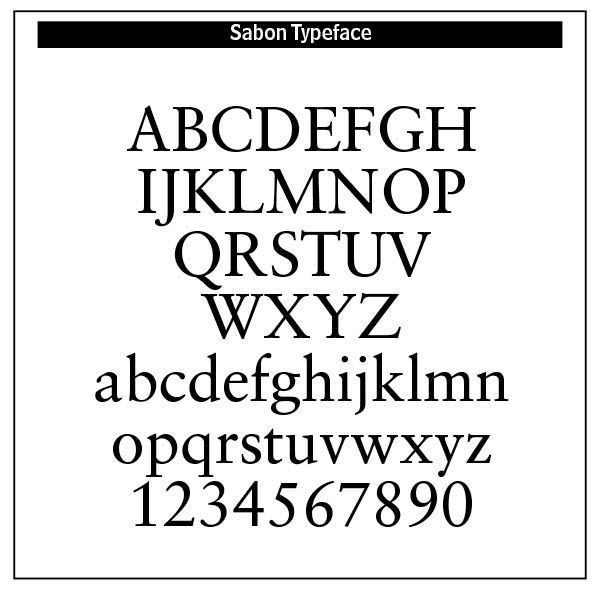
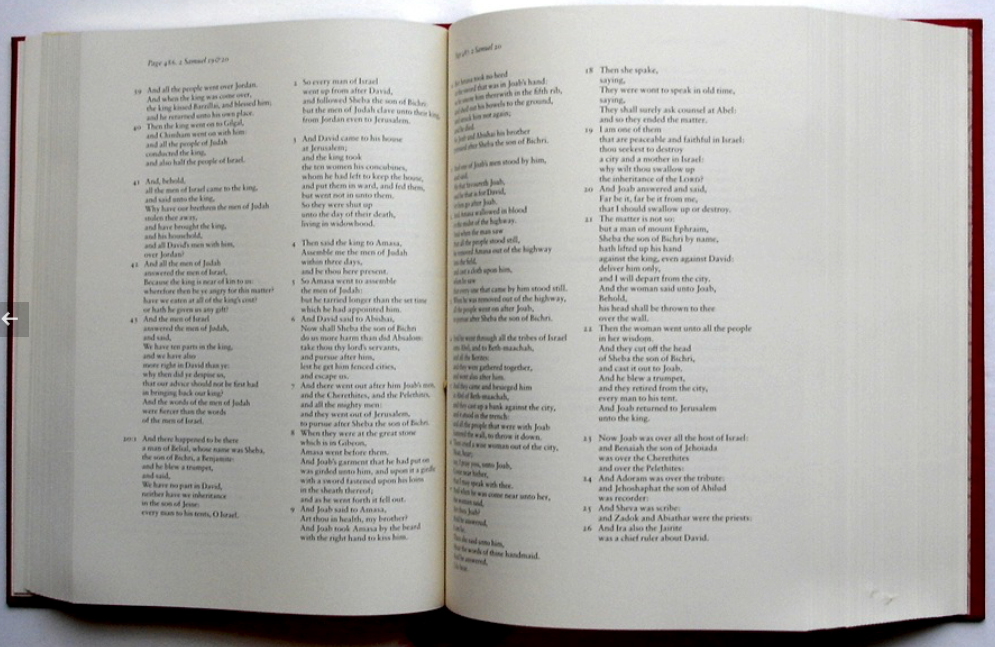
In typographic history, Herbert Bayer and Jan Tschichold, though not Russian, advanced the Constructivist cause. Jan Tschichold’s approach to typography was transformed after his first visit to the Bauhaus exhibition at Weimar. He became a leading advocate of Modernist design practices. But he was mostly interested in the practicality of typography. He developed the Sabon typeface, used by Bradbury Thompson in setting the Washburn College Bible.
Thompson, a descendent of a Presbyterian missionary in Kansas, was asked by Chicago publisher Marshall Field in 1969 to design a bible. Thompson used 10 x 14 inch pages and the Sabon type in 14-point.[4] He arranged the text in phrases, separating them where the reader naturally hesitated or stopped.
The project was abandoned in the early 1970s, but the Washburn College board accepted the offer of Olive White Garvey to underwrite the project. Its sales were to be used for a permanent display and tribute to Thompson and the Washburn Bible. The three-volume edition was published for sale in 1979. Oxford University Press published a smaller version, the Oxford edition of the Washburn College Bible, in 1980.
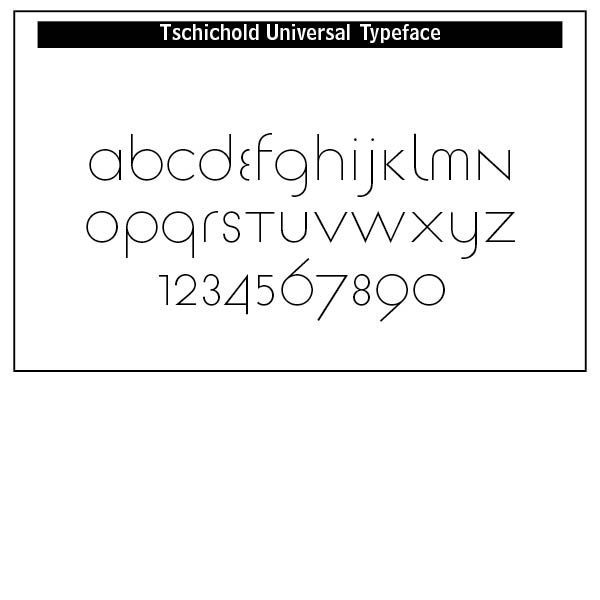
Being a practical Constructivist, Tschichold designed a “universal alphabet” to clean up the multigraphs (like ch and sch) and non-phonetic spellings in the German language. eu was replaced with oi, w with v and z with ts. The alphabet did not have capitals and was presented as one typeface in sans-serif style.[5]
Typography in Constructivism was a rational, disciplined and ideologically charged tool. It served society, especially early Russian forces, and reflected the spirit of the machine age. ChatGPT notes that the movement’s legacy endures in its clarity, structure and purpose-driven design that define much of modern typographic practice.
The beauty of Constructivism lies in its purpose driven uniformity and its legacy to the Bauhaus movement. Bold, clean lines of sans-serif type continue to influence poster and movement designers today.
In early Russia, theology was deeply Orthodox, mystical, and rooted in the lived experience of the Church. God was understood primarily through worship, icons, and ascetic practice, not abstract reasoning. Russian Christianity emphasized the mystery of God, the sanctity of the Church, and the union of divine and human through Christ. Typography was dominated by old-style Cyrillic typefaces rooted in religious and imperial traditions.
However, in the early 1900s a decisive shift toward functionalism and social progress dominated typography and art in Russia. This was a shift away from religious, God centered roots and into more Marxist oriented politics. Beauty in typography in its gratuitous form, reflecting the eternal gratuity and self-giving of the Trinity, was replaced by the State. Diversity was sacrificed for typographical uniformity.
Although Constructivism birthed Bauhaus typography, which became a worldwide typographical option, it was only as desirable as the political propaganda of the day required. Its purpose was State driven, not God driven or spiritually driven.
Notes
1. Founded by Kazimir Malevich, suprematism focused on pure abstraction and basic geometric forms and limited colors. Art was reduced to pure feeling and form. The imitation of natural shapes was rejected in suprematism.
2. Matthew Bingham, “Meditation” in A Heart Aflame for God: A Reformed Approach to Spiritual Formation (Wheaton, Il: Crossway Books, 2025. Kindle Edition), 131.
3. See https://en.wikipedia.org/wiki/El_Lissitzky for a more complete description of Lissitzky.
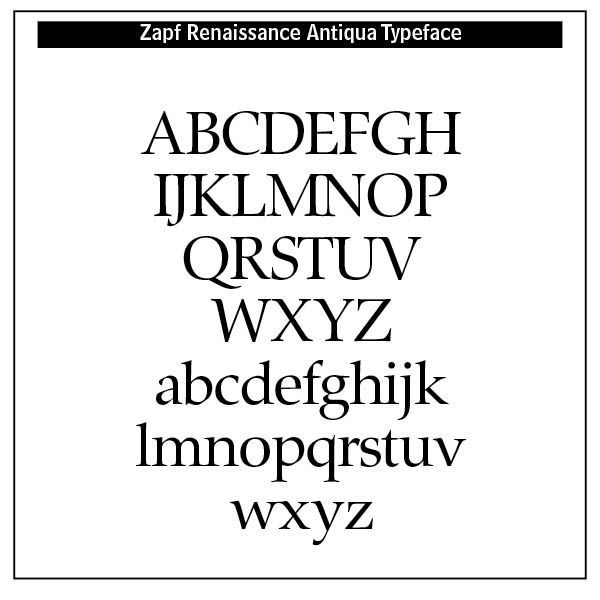
4. Some sites say this Bible was set in 14 point Garamond, but Sabon was the typeface used.
5. Notes on Jan Tschichold from https://en.wikipedia.org/wiki/Jan_Tschichold. Tschichold Universal Font from fontsgeek.com.