

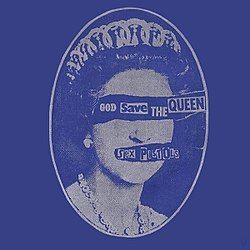
Album cover of God Save the Queen” by
Sex Pistols
Punk Type Theology
Visual Rebellion
“Then punk appeared and completely broke the rule book. It was shocking compared to everything else that was happening.”
(Sarah Hyndman)
RUB DOWN, HURRY UP LETRASET type was all the rage in Punk typography and artistry. Popular type faces that were used in Punk typography were the common Courier, Times, Time Bold Italic, Poplar (which is what this versal is in) and Helvetica Condensed, all available on rub down transfer sheets of the 1970s.
Punk type borrowed from Dada, Constructivism and situationist thinking, particularly in its use of cut-up text and ransom-note styling. Rejecting the grid systems of modernist design, Punk embraced disorder, distortion and noise. It was hand-made, urgent and gritty, sometimes illegible and always confrontational. It was fueled by do-it-yourself (DIY) ethics, anti-authoritarianism and the desire for disruption norms.
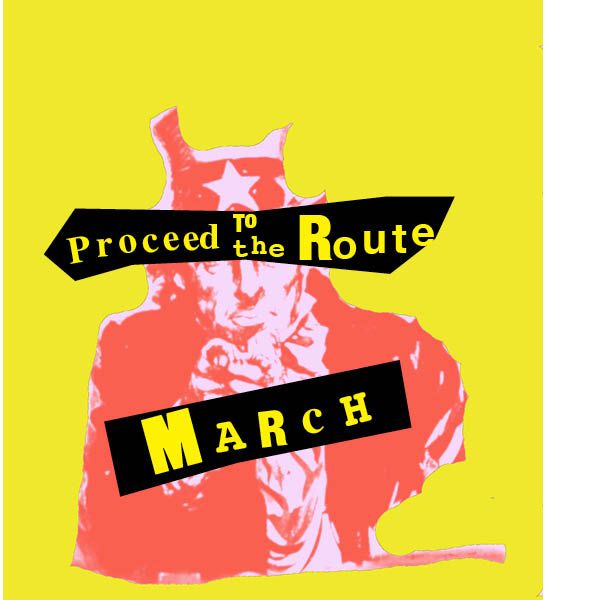
In the sample on the side panel, created by Adobe InDesign and using various standard fonts, with individual letters singly placed, we have a background poster of Uncle Sam’s World War Two call to arms, now quite distressed and used to promote a demonstration of sorts. The random placed type note is not all the same typeface, and the positioning looks like a child did this with cut up lettering. That’s the point of Punk. And Punk done rapidly with a clashing and obnoxious breaking out of any sort of grid.
In an interview of the typographer and designer Sarah Hyndman in London in 2016, she described the DIY sense of Punk typography this way — “There was no style– it’s all the types that were being used in the 1970s, but ripped up and mashed together in a mismatching way, then thrown back down on a page with felt tip scribbles. There was definitely no attention to kerning or leading. The theme that runs through is just this DIY immediacy.”[1] She goes on to say
It was completely new and innovative but there have been a few times in history where type has been ripped out of the grid and spilled across pages quite loosely and emotionally, such as the Dadaist and Futurist periods. But whereas before, revolutionary graphic posters would have had quite aesthetically beautiful typefaces, with punk it was clashing and obnoxious.[2]
Punk type was often printed at home using stick on Letraset or similar sheets of letters, or just cut up type from newspapers or magazines, or even just felt tipped pens to hand draw the type, and then plastered on walls, telephone poles and record shops. Flyers used cut-and-paste lettering, photocopied images, and handwritten text to announce shows quickly and cheaply. The typography mirrored the raw and confrontation mood of the 1970s.
A key designer of punk art was Jamie Reed who created iconic designs for the punk band, the Sex Pistols, with the song God Save The Queen, released during Queen Elizabeth II’s Silver Jubilee in 1977.[3] Reed, true to form, was also involved in direct action campaigns including the poll tax, Clause 28 and the Criminal Justice Bill in England. Reed was an avowed Druid.
Punk typography was anti-design by design. Breaking every rule of traditional typography, it reflected the urgency, anger and raw energy of the punk movement. Created with scissors, glue, typewriters and xerox machines, it made chaos a language of resistance and turned rough, messy type into a powerful voice for cultural dissent (ChatGPT). Punk typography paved the way for post-modern graphic design, influencing designers like David Carson and the grunge aesthetic of the 1990s.
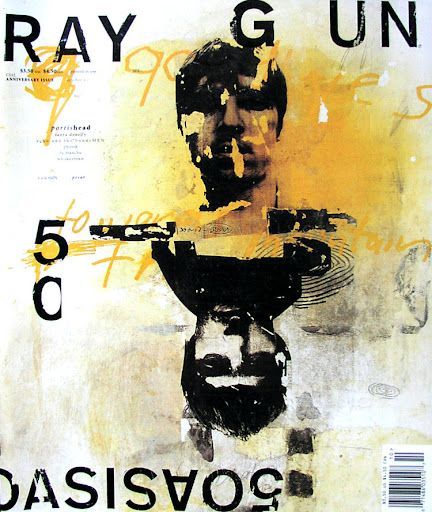
David Carson became a leading figure in post-modern graphic design. Trained as a sociologist and a professional surfer, Carson drew inspiration from surf culture, skateboarding, and an understanding of texture and movement in composition. He is most famous for his editorial design for magazines like Ray Gun (1992–1995), where layouts and typesetting challenge traditional magazine grid structures and pure functionality.[4]
Such typography also inspired later subcultures like hardcore, riot grrl, and DIY zine culture. Hardcore subcultural operates with a strong “us against the world” feeling, a lifestyle that abstains from alcohol, drugs and sometimes casual sex, and often aligns with ant-fascism, anti-capitalism, environmentalism and social justice campaigns.
Riot Grrl is a feminist punk movement that arose in the early 1990s predominantly in Olympia, Washington, Washington, D.C. and the Pacific Northwest. This, of course, was a defiant, DIY (Do-It-Yourself) response to the male dominated punk rock scene. It created space for women, queers and non-binary people.
DIY zine (pronounced “zeen”) is a self-publishing movement that emphasizes the values of punk typography. Zines are photocopies, handcrafted pamphlets or magazines outside the mainstream media. This is not a business venture, just a form of expression. Like Riot Grrl they can cover political activism and feminism. They also cover punk, metal, skate or comic-book culture.
Today punk type is often co-opted in fashion and advertising, though stripped of its rebellious roots.
The Theology of Punk
Punk type follows a philosophy, and indeed, a theology of disruption. Traditional typography generally seeks clarity, order, hierarchy, consistency, and refinement. Punk typography deliberately questioned these values. Punk designers used type to challenge the visual conventions of advertising, newspapers, corporate identity, publishing, and polite society. Instead of asking “How can this information be beautifully organized?”, punk typography often asked, “How can the form itself disturb the viewer?”
Punk therefore embraced things that conventional graphic design tended to eliminate — torn edges, uneven spacing, crude lettering, mismatched typefaces, handwritten text, distorted letters, photocopy artifacts, random composition, excessive contrast, and visual clutter. The resulting typography could look accidental, even when carefully constructed.
The key to such typographical deconstruction is the typesetter or type designer — DIY or Do It Yourself. Punk musicians and publishers frequently lacked the resources of major record companies and advertising agencies. They therefore created their own flyers, posters, album covers, zines, newsletters, invitations, and handbills. The limitations became part of the aesthetic.
A typewriter, Letraset, photocopier, scissors, glue, and felt-tip pen could become a complete graphic-design system. This produced an important philosophical reversal — professional production was no longer necessary for cultural authority. Anyone could publish. Anyone did publish. This is not desktop publishing with a computer or laptop. This is autonomous humanity seizing self-proclaimed control of media production and distribution.
Such reckless autonomy was seen in how type and messaging were appropriated from other sources, including newspapers, ransom notes, advertising, propaganda, Victorian printing, comic books, handwriting, typewriters, military graphics, corporate logos, and fashion magazines. The famous ransom-note aesthetic, for example, deliberately assembled letters from different sources. The resulting typography communicates something important — language and authority can be cut apart and reconstructed.
Punk typography can instead say, “The difficulty of reading is part of the message.” Extreme examples use overlapping letters, reversed type, extreme distortion, irregular baselines, tiny text, enormous headlines, blacked-out areas, and fragmented words. The typography becomes almost physical rather than merely linguistic. This makes punk typography related to the broader twentieth-century tradition of experimental typography, particularly Dada, Futurism, Constructivism, and later New Wave typography.
Punk type is cultural sabotage, promoting intentional social and cultural chaos. Punk could use typography to interrupt persuasion. A punk poster might resemble an advertisement while simultaneously destroying the conventions of advertising. The viewer recognizes the familiar language of commercial culture but sees it being deliberately corrupted. As a result, punk typography frequently operates through appropriation then distortion then confrontation. Much of their visual language was more systematic and politically charged, associated with anarchism, anti-war activism, feminism, and opposition to consumer culture. The question shifted from “Why obey the rules?” to “Who created the rules, and whom do they serve?”
Theologically, this is the old Babel story retold in punk typography and visual media. What is important is the Situationist concept of détournement — taking an existing cultural image or message and turning it against its original purpose.
Punk typography, however, became a paradox. An anti-design style eventually became a recognizable design style. Once the ransom-note collage, distressed lettering, photocopy texture, and deliberately crude typography became recognizable as “punk,” they could themselves become commercial conventions. This raises the question — Can rebellion remain rebellious once it becomes a style that can be bought and sold? That tension continues in contemporary graphic design.
Punk typography transforms typography from a neutral servant of orderly communication into an instrument of rebellion, appropriation, DIY production, cultural critique, and visual disruption. It is particularly interesting when placed historically between Dada then Situationism then Punk then New Wave then contemporary grunge/distressed typography, because each stage asks increasingly difficult questions about whether breaking typographic rules is itself capable of becoming a new set of rules.
Punk typographically forces us to see God’s world in its desperate sin-ridden condition and the cross of Christ as its only answer. While this book is not meant as a theological treatise or evangelistic tract, typography like punk causes us not to overlook the depth and weight of the human sinful condition without the presence of God.
Notes
1. From an interview in the UK at https://www.designweek.co.uk/issues/24-30-october-2016/sarah-hyndman-punk-anti-helvetica/.
2. Ibid.
3. Information and graphics from Wikipedia at https://en.wikipedia.org/wiki/Jamie_Reid.
4. From ChatGPT about David Carson.